Juniper JN0-683基礎訓練 & JN0-683受験記
Wiki Article
P.S. ShikenPASSがGoogle Driveで共有している無料かつ新しいJN0-683ダンプ:https://drive.google.com/open?id=1K9lWDppPGmO5wOUyQyiuxmb9dTT5M8sd
最も効率的で直感的な学習方法を学習者に提供し、学習者が効率的に学習できるように最善を尽くします。 JN0-683試験リファレンスは、クライアントにインスタンスを提供し、クライアントが直感的に理解できるようにします。ナレッジポイントを具体的に示すためのJN0-683テストガイドのインスタンスがあるという考慮事項に基づいています。実際のJN0-683試験を刺激することにより、クライアントは実際のJN0-683試験練習問題の習熟度を理解できます。したがって、クライアントは抽象的な概念を直感的に理解できます。
Juniper JN0-683 認定試験の出題範囲:
| トピック | 出題範囲 |
|---|---|
| トピック 1 |
|
| トピック 2 |
|
| トピック 3 |
|
| トピック 4 |
|
| トピック 5 |
|
試験の準備方法-認定するJN0-683基礎訓練試験-最新のJN0-683受験記
今後のJN0-683学習教材について心配がある場合は、学習教材が問題の解決に役立ちます。弊社のJN0-683学習教材の高品質をお約束するために、当社には優れた技術スタッフがおり、販売後の完璧なサービスシステムがあります。さらに重要なことは、当社のJN0-683ガイド質問と完璧なアフターサービスが、地元および海外のお客様に認められていることです。模擬試験に合格する場合は、学習エンジンが必須の選択肢になると考えています。過去数年間、JN0-683ガイドの質問を購入する人が増えています。
Juniper Data Center, Professional (JNCIP-DC) 認定 JN0-683 試験問題 (Q58-Q63):
質問 # 58
You are implementing VXLAN broadcast domains in your data center environment. Which two statements are correct in this scenario? (Choose two.)
- A. Layer 2 frames are encapsulated by the source VTEP.
- B. A VXLAN packet does not contain a VLAN ID.
- C. The VNI is a 16-bit value and can range from 0 through 16.777.215.
- D. The VNI must match the VLAN tag to ensure that the remote VTEP can decapsulate VXLAN packets.
正解:A、B
解説:
* VXLAN Overview:
* VXLAN (Virtual Extensible LAN) is a network virtualization technology that encapsulates Layer
2 Ethernet frames into Layer 3 UDP packets for transmission over an IP network. It allows the creation of Layer 2 overlay networks across a Layer 3 infrastructure.
* Understanding VXLAN Components:
* VTEP (VXLAN Tunnel Endpoint):A VTEP is responsible for encapsulating and decapsulating Ethernet frames into and from VXLAN packets.
* VNI (VXLAN Network Identifier):A 24-bit identifier used to distinguish different VXLAN segments, allowing for up to 16 million unique segments.
* Correct Statements:
* C. Layer 2 frames are encapsulated by the source VTEP:This is correct. In a VXLAN deployment, the source VTEP encapsulates the original Layer 2 Ethernet frame into a VXLAN packet before transmitting it over the IP network to the destination VTEP, which then decapsulates it.
* A. A VXLAN packet does not contain a VLAN ID:This is correct. The VXLAN header does not carry the original VLAN ID; instead, it uses the VNI to identify the network segment. The VLAN ID is local to the switch and does not traverse the VXLAN tunnel.
* Incorrect Statements:
* B. The VNI must match the VLAN tag to ensure that the remote VTEP can decapsulate VXLAN packets:This is incorrect. The VNI is independent of the VLAN tag, and the VLAN ID does not need to match the VNI. The VNI is what the remote VTEP uses to identify the correct VXLAN segment.
* D. The VNI is a 16-bit value and can range from 0 through 16,777,215:This is incorrect because the VNI is a 24-bit value, allowing for a range of 0 to 16,777,215.
Data Center References:
* VXLAN technology is critical for modern data centers as it enables scalability and efficient segmentation without the constraints of traditional VLAN limits.
質問 # 59
Click the Exhibit button. You are troubleshooting a DCI connection to another data center. The BGP session to the provider is established, but the session to Border-Leaf-2 is not established.
Referring to the exhibit, which configuration change should be made to solve this problem?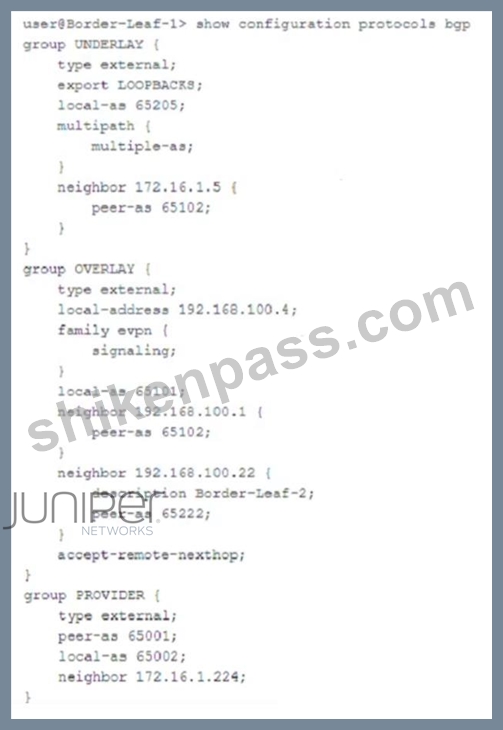
- A. delete protocols bgp group UNDERLAY advertise-external
- B. set protocols bgp group PROVIDER export LOOPBACKS
- C. delete protocols bgp group OVERLAY accept-remote-nexthop
- D. set protocols bgp group overlay export loopbacks
正解:C
解説:
The "accept-remote-nexthop" statement allows the router to accept prefixes with a next hop that is not directly connected, which can cause BGP neighbor sessions to fail if not needed or properly supported.
Removing "accept-remote-nexthop" from the OVERLAY group is a common fix to resolve BGP session establishment issues with EVPN neighbors.
質問 # 60
You are asked to automatically provision new Juniper Networks devices in your network with minimal manual intervention Before you begin, which two statements are correct? (Choose two.)
- A. You must have a file server that stores software image and configuration files.
- B. You must have a DHCP server that provides the location of the software image and configuration files.
- C. You must have a system log (syslog) server to manage system log messages and alerts.
- D. You must have an NTP server to perform time synchronization.
正解:A、B
解説:
* Zero-Touch Provisioning (ZTP):
* ZTP is a feature that allows for the automatic provisioning of devices with minimal manual intervention. It is widely used in large-scale deployments to quickly bring new devices online.
* Key Requirements for ZTP:
* A. DHCP Server:A DHCP server is crucial for ZTP as it provides the necessary information to new devices, such as the IP address, the location of the software image, and configuration files.
* D. File Server:The file server is where the software image and configuration files are stored. The device downloads these files during the provisioning process.
* Incorrect Options:
* B. Syslog Server:While a syslog server is important for logging and monitoring, it is not a requirement for the initial provisioning process.
* C. NTP Server:An NTP server is used for time synchronization, which is essential for accurate logging and operation but not specifically required for ZTP.
Data Center References:
* ZTP simplifies the deployment process by automating the initial configuration steps, relying heavily on DHCP for communication and a file server for delivering the necessary configuration and software.
質問 # 61
You are designing an IP fabric tor a large data center, and you are concerned about growth and scalability. Which two actions would you take to address these concerns? (Choose two.)
- A. Use QFX5700 Series devices as the super spines.
- B. Design a three-stage Clos IP fabric.
- C. Design a five-stage Clos IP fabric.
- D. Use EX4300 Series devices as the spine devices.
正解:A、C
解説:
Design a five-stage Clos IP fabric: A five-stage Clos fabric architecture provides greater scalability and can support larger numbers of spine and leaf switches compared to a traditional three-stage Clos fabric, thus better addressing growth.
Use QFX5700 Series devices as the super spines: The QFX5700 series is a high-performance switch suitable for use as super-spines in large-scale data center IP fabrics. These devices offer high throughput and low latency, making them ideal for managing the large amount of traffic typically seen in high-growth environments. Using such devices for the super-spine layer will support scalability and performance as the data center grows.
質問 # 62
Exhibit.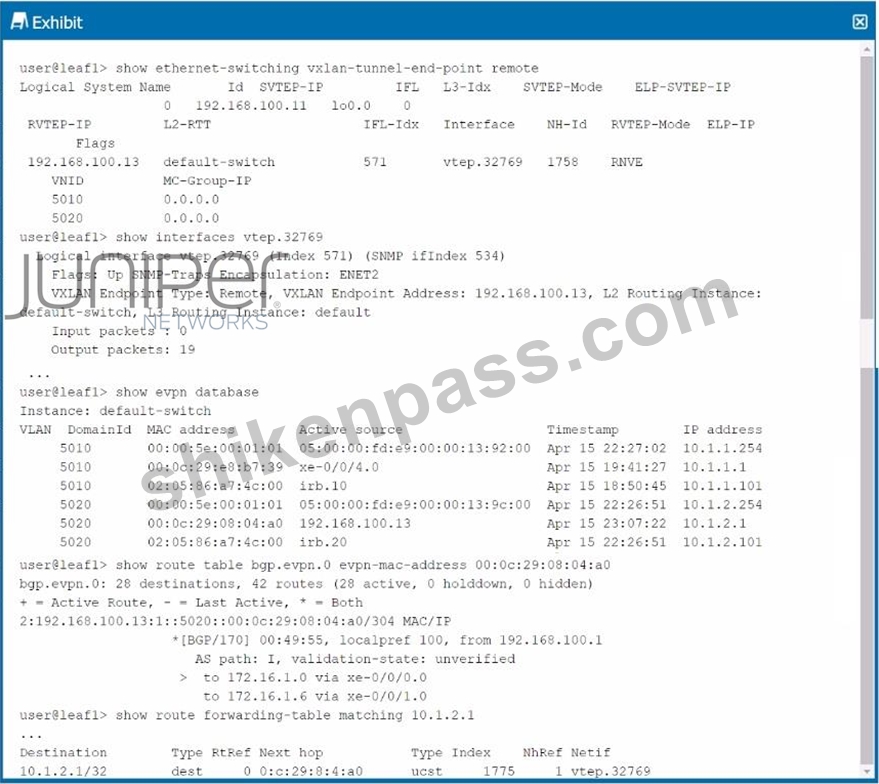
Referring to the exhibit, Host1 (10.1.1.1) is failing to communicate with Host2 (10.1.2.1) in a data center that uses an ERB architecture. What do you determine from the output?
- A. The traffic is entering the VXLAN tunnel.
- B. The irb.20 interface is not configured on leaf1.
- C. The traffic is failing because load balancing is not configured correctly.
- D. Host1 and Host2 are directly connected to leaf1.
正解:A
解説:
Understanding the Problem:
* Host1 (10.1.1.1) is failing to communicate with Host2 (10.1.2.1) within an EVPN-VXLAN environment using ERB architecture.
Analysis of the Exhibit:
* The provided output includes information from the show route forwarding-table matching command for IP 10.1.2.1. The next hop is shown as vtep.32769, which indicates that the traffic destined for 10.1.2.1 is being forwarded into the VXLAN tunnel with the correct VTEP (VXLAN Tunnel Endpoint).
Conclusion:
* Option B:Correct-The traffic from Host1 is entering the VXLAN tunnel, as evidenced by the next hop pointing to a VTEP. However, the issue could lie elsewhere, possibly with the remote VTEP, routing configurations, or the receiving leaf/spine devices.
質問 # 63
......
成功への道を示す指標として、私たちの練習資料はあなたの旅のあらゆる困難を乗り越えることができます。すべての課題をウォークインのように扱うことはできませんが、JN0-683シミュレーションの実践により、レビューを効果的にすることができます。それが彼らがラインのプロモデルである理由です。私たちは品質の問題に非妥協的であり、あなたは彼らの習熟度を厳しく完全に確信することができます。
JN0-683受験記: https://www.shikenpass.com/JN0-683-shiken.html
- 100%合格率のJN0-683基礎訓練 - 合格スムーズJN0-683受験記 | 効率的なJN0-683日本語講座 ☀ ☀ JN0-683 ️☀️を無料でダウンロード➥ www.xhs1991.com ????で検索するだけJN0-683復習問題集
- 便利なJN0-683基礎訓練 - 合格スムーズJN0-683受験記 | 有難いJN0-683日本語講座 ???? ( www.goshiken.com )から簡単に➠ JN0-683 ????を無料でダウンロードできますJN0-683日本語受験攻略
- 試験の準備方法-完璧なJN0-683基礎訓練試験-正確的なJN0-683受験記 ???? ( www.topexam.jp )の無料ダウンロード「 JN0-683 」ページが開きますJN0-683無料問題
- 試験の準備方法-完璧なJN0-683基礎訓練試験-正確的なJN0-683受験記 ???? 今すぐ▛ www.goshiken.com ▟を開き、{ JN0-683 }を検索して無料でダウンロードしてくださいJN0-683日本語対策
- 信頼的なJuniper JN0-683基礎訓練 - 合格スムーズJN0-683受験記 | 真実的なJN0-683日本語講座 ???? URL { www.xhs1991.com }をコピーして開き、【 JN0-683 】を検索して無料でダウンロードしてくださいJN0-683専門知識訓練
- JN0-683対応受験 ???? JN0-683合格問題 ???? JN0-683学習資料 ???? 「 www.goshiken.com 」は、【 JN0-683 】を無料でダウンロードするのに最適なサイトですJN0-683学習指導
- 完璧なJN0-683基礎訓練試験-試験の準備方法-信頼的なJN0-683受験記 ???? ▛ www.mogiexam.com ▟から簡単に➤ JN0-683 ⮘を無料でダウンロードできますJN0-683シュミレーション問題集
- JN0-683試験問題集 ???? JN0-683合格問題 ???? JN0-683日本語受験攻略 ???? 検索するだけで➠ www.goshiken.com ????から⇛ JN0-683 ⇚を無料でダウンロードJN0-683練習問題集
- JN0-683対応受験 ???? JN0-683認定資格試験問題集 ???? JN0-683合格率書籍 ???? { www.xhs1991.com }を開いて{ JN0-683 }を検索し、試験資料を無料でダウンロードしてくださいJN0-683学習資料
- 完璧なJN0-683基礎訓練試験-試験の準備方法-信頼的なJN0-683受験記 ???? [ www.goshiken.com ]に移動し、「 JN0-683 」を検索して、無料でダウンロード可能な試験資料を探しますJN0-683合格問題
- JN0-683練習問題集 ???? JN0-683対応受験 ???? JN0-683試験時間 ➿ ウェブサイト➽ www.xhs1991.com ????から➠ JN0-683 ????を開いて検索し、無料でダウンロードしてくださいJN0-683キャリアパス
- ammaryfvp252194.cosmicwiki.com, maebmza368919.thenerdsblog.com, graysonzojv424126.westexwiki.com, bookmarkblast.com, ambervhgk438738.ktwiki.com, hannaqzpg977986.atualblog.com, bookmarksoflife.com, ronaldygym451818.wikilima.com, letusbookmark.com, amaanbxuu750966.spintheblog.com, Disposable vapes
さらに、ShikenPASS JN0-683ダンプの一部が現在無料で提供されています:https://drive.google.com/open?id=1K9lWDppPGmO5wOUyQyiuxmb9dTT5M8sd
Report this wiki page